
What is a healthy BMI after menopause?
For postmenopausal women under 65, the healthy BMI range is the same as for all adults: 18.5–24.9, as defined by the WHO and CDC. From about 65, research on older adults links the lowest risk of death with a slightly higher BMI, roughly 24–31, and a higher risk below 23. Women of Asian, Middle Eastern, Black African or African-Caribbean background may be advised to use lower thresholds, with risk rising from a BMI of 23.
| Stage | BMI guide | Add this check |
|---|---|---|
| Perimenopause (often mid-40s) | 18.5–24.9 | Start measuring your waist; changes often show there first. |
| Postmenopause, under 65 | 18.5–24.9 | Waist under 35 in (88 cm) and waist-to-height ratio under 0.5. |
| 65 and over | 18.5–24.9 officially; about 24–31 linked to lowest mortality | Watch for unintended weight loss and loss of strength. |
For a full height-by-height breakdown, see the BMI chart for women. For how the reading changes across every decade, see BMI for women by age.
What changes in your body during menopause?
Menopause is confirmed 12 months after your last period. In the US the average age is 52, and the transition leading up to it (perimenopause) usually lasts about seven years, though it can be shorter or longer, according to the National Institute on Aging. As estrogen levels fall and fluctuate, body composition changes in three main ways:
- Fat moves to the belly. Before menopause, estrogen favours storing fat on the hips and thighs. Afterwards, more is stored as visceral fat around the organs, which is linked to heart disease, type 2 diabetes and some cancers.
- Muscle declines. The long-running SWAN study, which followed women through the transition with DEXA scans, found that during the menopause transition fat gain roughly doubles its pace and lean mass begins to fall. These changes started in the years before the final period and levelled off about two years after it.
- Bone thins. Bone loss speeds up for several years after menopause, raising the risk of osteoporosis.
An important point from the research: menopause mainly changes where fat goes and how much muscle you keep. A review in Climacteric (2012) concluded that the weight gain many women notice in midlife is driven largely by ageing and lifestyle, while the hormonal change drives the shift of fat to the abdomen. For the causes of midlife weight gain and how to manage it, see our guide to menopause weight gain.
Why can BMI be misleading after menopause?
BMI can mislead after menopause because it can't tell fat from muscle, or belly fat from hip fat. A woman can keep the same BMI from 45 to 60 while losing muscle, gaining visceral fat and increasing her health risk, and the number won't show it.
A 2018 study in the journal Menopause compared BMI with DEXA-measured body fat in postmenopausal women. A BMI of 30 or more was very good at confirming high body fat when it flagged it, but it missed a large share of women whose body-fat percentage was in the obesity range. This pattern, a "normal" BMI with high body fat, is sometimes called normal-weight obesity, and in a large US study it was linked to a higher rate of metabolic problems and, in women, higher cardiovascular mortality.
Two more effects push in the same direction:
- Height loss. Many women lose height with age as spinal discs compress and bones thin. Because BMI divides by height squared, a shorter measured height raises BMI even if weight hasn't changed. Use your current measured height, not the one on an old ID.
- Fluid and muscle shifts. If you lose muscle and gain fat in equal amounts, your weight and BMI stay flat while your body composition worsens.
Read more on this in BMI vs body fat.
What should you measure instead of (or as well as) BMI?
The most useful extra measure after menopause is your waist, because it reflects the belly fat that BMI misses. Track it alongside BMI, ideally every few months, so you see changes early.
| Measure | Healthy target for women | Why it helps |
|---|---|---|
| Waist circumference | Under 35 in (88 cm) | Directly reflects belly fat. NIH threshold for increased risk. |
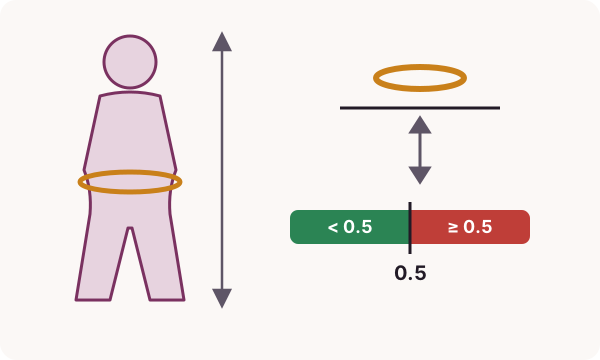
| Waist-to-height ratio | Under 0.5 | Adjusts waist for height. NICE recommends it for all adults. See the chart. |
| Body fat % | About 21–31% (fitness to average) | Shows fat vs muscle. Best measured by DEXA scan. |
| BMI | 18.5–24.9 | Still a useful starting point and tracks change over time. |
Our BMI calculator for women calculates all of these at once. Choose Perimenopause or postmenopause as your life stage and add your waist for the most accurate picture. For other ways to estimate fat, see the body fat percentage guide for women.
What waist size should you aim for at your height?
A waist-to-height ratio under 0.5 means your waist is less than half your height. NICE uses 0.5 to 0.59 as increased risk and 0.6 or more as high risk. Here is what half your height works out to:
| Height | Waist for a ratio of 0.5 | Waist for a ratio of 0.6 |
|---|---|---|
| 5′0″ (152 cm) | 30 in (76 cm) | 36 in (91 cm) |
| 5′2″ (157 cm) | 31 in (79 cm) | 37.2 in (94 cm) |
| 5′4″ (163 cm) | 32 in (81 cm) | 38.4 in (98 cm) |
| 5′6″ (168 cm) | 33 in (84 cm) | 39.6 in (101 cm) |
| 5′8″ (173 cm) | 34 in (86 cm) | 40.8 in (104 cm) |
| 5′10″ (178 cm) | 35 in (89 cm) | 42 in (107 cm) |
For shorter women, half your height is a stricter target than the 35-inch rule; for taller women the two are close. If your waist is between the two columns, you are in the increased-risk band. That is worth discussing with your doctor along with your blood pressure, cholesterol and blood sugar.
Worked examples: same BMI, different picture
Example 1. Carol is 5′5″ (165 cm) and has weighed 145 lb (66 kg) since her early 40s. Her BMI is 24.1, in the healthy range, at 44 and at 58. But her waist has grown from 31 to 35 inches (79 to 89 cm). Her waist-to-height ratio has gone from 0.48 to 0.54, from healthy to increased risk. Using the Relative Fat Mass formula (76 − 20 × height ÷ waist), her estimated body fat has risen from about 34% to about 39%, even though the scale hasn't moved.
Example 2. Linda is 5′3″ (160 cm) and weighs 150 lb (68 kg), a BMI of 26.6, which is in the overweight range. She lifts weights twice a week and her waist is 30 inches (76 cm), a ratio of 0.48. Her BMI suggests extra risk, but her waist points the other way. Her doctor may look at her blood tests and blood pressure before drawing any conclusions.
These examples show why no single number gives the whole picture. Estimates such as RFM are approximations; a DEXA scan is the most accurate way to measure body fat, but it is not routinely needed.
How to measure your waist correctly
- Stand up straight and breathe out normally.
- Find the top of your hip bones and wrap a tape measure around your middle just above them.
- Keep the tape snug but not pressing into the skin, and parallel to the floor.
- Measure twice and use the average.
Measure on bare skin, at the same time of day, ideally in the morning before eating. Bloating can add an inch or more later in the day, so consistency matters more than the exact time you choose.
How often should you check your BMI and waist?
Every three to six months is enough for most women. Body composition changes slowly, and checking more often mostly picks up day-to-day noise from fluid, bloating and the time of day. A simple routine:
- Weight and BMI: same scale, same time of day, light clothing. Enter the result in the calculator with your life stage set to perimenopause or postmenopause.
- Waist: measured as described above, twice, using the average.
- Height: re-measure once a year against a wall, standing straight without shoes. A loss of more than an inch or two is worth mentioning to your doctor, as it can be a sign of spinal bone loss.
- Strength: notice whether everyday tasks, such as rising from a chair without using your hands or carrying shopping, are getting harder. Loss of strength often shows up before any change on the scale.
Write the numbers down so you can see the direction of travel. A waist that grows steadily over a year is more useful information than any single reading.
Does a healthy BMI change after 65?
Officially no, but the evidence suggests a little extra weight is not harmful in later life. A 2014 meta-analysis in the American Journal of Clinical Nutrition of adults aged 65 and over found the lowest risk of death at a BMI of roughly 24–31, with risk rising below 23. At this stage, losing muscle (sarcopenia) and unintended weight loss are bigger concerns than a BMI a little above 25.
So after 65 the focus shifts from reaching a lower number to keeping strength, mobility and bone. If you are thinking about losing weight at this age, talk to your doctor first, as dieting without enough protein and exercise can speed up the loss of muscle and bone. Our guide to BMI for older women covers this stage in detail.
What helps during and after menopause?
The habits that protect your health after menopause focus on muscle, bone and belly fat rather than the number on the scale:
- Strength training two or more times a week to protect muscle and bone. The WHO recommends muscle-strengthening activity on at least two days a week for all adults.
- Enough protein spread across meals to support muscle. An expert group (PROT-AGE) suggests 1.0–1.2 g per kg of body weight a day for healthy adults over 65.
- 150 minutes of moderate activity a week, such as brisk walking, cycling or swimming.
- Sleep. Hot flushes and night sweats disrupt it, and poor sleep drives appetite. Treating symptoms can help.
- Less alcohol, which adds calories and can worsen hot flushes and sleep.
- Talk to your doctor about symptoms, bone density screening and whether hormone therapy suits you.
For more on why the scale creeps up and what to do about it, see our guide to menopause weight gain.
Does hormone therapy change your BMI?
Hormone therapy doesn't appear to cause weight gain. A Cochrane review of randomised trials found no evidence that estrogen, with or without progestogen, affects body weight compared with placebo, and some trials suggest it may reduce the shift of fat to the abdomen. The Menopause Society's 2022 position statement says the benefits of hormone therapy most often outweigh the risks for healthy women with symptoms who are under 60 or within 10 years of menopause.
Hormone therapy is prescribed for symptoms such as hot flushes, not for weight. Whether it's right for you depends on your symptoms and health history, so discuss it with your doctor.
When should you talk to your doctor?
See your doctor if your waist is 35 inches (88 cm) or more, or your waist-to-height ratio is 0.5 or higher, especially with a family history of heart disease or diabetes. They can check blood pressure, cholesterol and blood sugar, which tell you more about risk than BMI alone. Also get advice if you lose weight without trying, as that can be a sign of an underlying condition, or if your BMI is under 18.5.
Bone health deserves its own check. The US Preventive Services Task Force (2025) recommends osteoporosis screening for all women 65 and over, and for younger postmenopausal women at increased fracture risk. Ask whether you need a bone density (DEXA) scan.
This page is for information only. See our medical disclaimer.
Frequently asked questions
What is a healthy BMI after menopause?
The standard healthy range of 18.5–24.9 still applies, but BMI can underestimate body fat after menopause because muscle declines and fat moves to the belly. Pair it with a waist under 35 inches (88 cm) and a waist-to-height ratio under 0.5.
Why do women gain belly fat during menopause?
Falling estrogen changes where the body stores fat, shifting it from the hips and thighs to the abdomen. Research from the SWAN study found fat gain roughly doubles and lean mass starts to decline during the menopause transition, even when total weight changes little.
Is a BMI of 26 bad for a postmenopausal woman?
Not necessarily. A BMI of 26 is in the overweight range, but your waist, blood pressure, blood sugar and fitness say more about your risk. After 65, research links a BMI in the mid-20s with the lowest risk of death. Ask your doctor to look at the whole picture.
Should my BMI go up after menopause?
BMI often rises a little in midlife, mostly because of ageing and lifestyle, and height loss can raise it further. A gradual change is common, but a growing waist is the more important signal to act on.
Can my BMI be normal while my body fat is high after menopause?
Yes. Because muscle declines and fat moves inward, many postmenopausal women have a BMI under 25 but a high body-fat percentage, sometimes called normal-weight obesity. A waist of 35 inches (88 cm) or more, or a waist-to-height ratio of 0.5 or more, is a practical sign to look out for.
Does hormone therapy affect weight?
Studies suggest menopausal hormone therapy does not cause weight gain and may reduce the shift of fat to the abdomen. Whether it is right for you depends on your symptoms and health history, so discuss it with your doctor.
What is the best body fat percentage for a woman after menopause?
There is no separate postmenopausal target. Using American Council on Exercise norms, about 21–31% is the fitness-to-average range for women. Body fat tends to rise with age, so focus on keeping muscle rather than a specific percentage.
Sources
- Greendale GA et al. Changes in body composition and weight during the menopause transition (SWAN). JCI Insight 2019
- Banack HR et al. Is BMI a valid measure of obesity in postmenopausal women? Menopause 2018
- National Institute on Aging – What is menopause?
- Davis SR et al. Understanding weight gain at menopause. Climacteric 2012;15:419–429
- Romero-Corral A et al. Normal weight obesity: a risk factor for cardiometabolic dysregulation and cardiovascular mortality. Eur Heart J 2010;31:737–746
- NHLBI (NIH) – Assessing your weight and health risk
- NICE – Overweight and obesity management (waist-to-height ratio)
- WHO Expert Consultation. Appropriate BMI for Asian populations. Lancet 2004;363:157–163
- Winter JE et al. BMI and all-cause mortality in older adults: a meta-analysis. Am J Clin Nutr 2014;99:875–890
- Bauer J et al. Evidence-based recommendations for optimal dietary protein intake in older people: a position paper from the PROT-AGE Study Group. J Am Med Dir Assoc 2013;14:542–559
- WHO – Physical activity fact sheet
- Norman RJ, Flight IH, Rees MC. Oestrogen and progestogen hormone replacement therapy for peri-menopausal and post-menopausal women: weight and body fat distribution. Cochrane Database Syst Rev 2000;(2):CD001018
- The 2022 hormone therapy position statement of The North American Menopause Society. Menopause 2022;29:767–794
- Woolcott OO, Bergman RN. Relative fat mass (RFM) as a new estimator of whole-body fat percentage. Sci Rep 2018
- American Council on Exercise – Percent body fat norms (archived)
- US Preventive Services Task Force – Screening for osteoporosis to prevent fractures: final recommendation statement, 2025
- CDC – Adult BMI categories